Summary: The best choice depends on your household’s hot water needs, budget, and long-term efficiency goals. Traditional tank water heaters typically cost less upfront and offer straightforward replacement, while tankless water heaters provide on-demand hot water, greater energy efficiency, a longer lifespan, and a space-saving design.
When your water heater starts showing its age, it’s tempting to replace it with whatever you’ve always had. But today’s homeowners have more choices than ever before, and one of the biggest decisions is whether to stick with a traditional storage tank or upgrade to a tankless system.
If you live in the Mid-Atlantic area, your water heater works hard year-round, from hot showers on chilly winter mornings to extra laundry, dishes, and guests during the summer. Choosing the right system can improve comfort, lower energy costs, and even free up valuable space in your home.
So, when it comes to a tankless vs. tank water heater system, which one is the better fit? The answer depends on your household’s hot water needs, your budget, and your long-term goals.
How Traditional Tank Water Heaters Work
A traditional water heater stores hot water in an insulated tank, typically holding between 40 and 80 gallons. The unit continuously heats the stored water so it’s ready whenever you turn on a faucet.
When hot water is used, the tank refills with cold water and reheats it for the next use.
Pros of Tank Water Heaters
Traditional tanks remain popular for several reasons:
- Lower upfront purchase and installation costs
- Straightforward replacement if you’re already using a tank system
- Reliable performance for average households
- Easier and less expensive repairs in many cases
For many homeowners, especially those replacing an aging unit with minimal modifications, a storage tank remains a practical and dependable solution.
Cons of Tank Water Heaters
Tank systems also have some limitations.
Because they store a finite amount of hot water, large families may occasionally run out during periods of heavy use. They also use energy throughout the day to maintain water temperature (even when no one is using hot water).
In addition, the storage tank takes up more floor space and generally has a shorter lifespan than many tankless models.
How Tankless Water Heaters Work
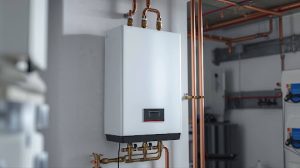
Rather than storing hot water, tankless systems heat water only when you need it.
When you turn on a hot water tap, cold water passes through a heat exchanger that rapidly warms it before delivering it directly to your fixtures.
Since there’s no storage tank, homeowners enjoy a nearly endless supply of hot water (as long as the system is properly sized for the household).
This on-demand operation is one of the biggest benefits of tankless water heater technology, but there are many other benefits as well.
Benefits of Tankless Water Heaters
Many Mid-Atlantic homeowners are choosing tankless systems because they offer several attractive advantages.
Endless Hot Water
If your family often schedules back-to-back showers, runs the dishwasher while doing laundry, or frequently hosts guests, a properly sized tankless unit can keep hot water flowing without waiting for a storage tank to recover.
Improved Energy Efficiency
Since tankless systems only heat water when it’s needed, they eliminate the standby heat loss associated with storage tanks. That can translate into lower utility bills over time, particularly for households with moderate hot water usage.
Longer Equipment Life
While many traditional tank water heaters last around 8 to 12 years, tankless systems often provide 15 to 20 years (or even longer with proper care).
Compact Design
Without a large storage tank, tankless units mount neatly on a wall and require significantly less floor space, making them ideal for smaller utility rooms, finished basements, or mechanical closets.
Related: HVAC Innovations: What’s New and What’s Worth Installing?
Tankless Water Heater Maintenance
Like any appliance, tankless systems perform best with routine care. Regular tankless water heater maintenance helps prevent mineral buildup inside the heat exchanger, especially in areas with hard water, and keeps the system operating efficiently.
Annual flushing is often recommended, along with periodic inspections to ensure safe, reliable performance.
Traditional tanks also benefit from maintenance, including sediment flushing and anode rod inspections, but tankless units generally require more consistent preventive service to maintain peak efficiency.
Understanding Tankless Water Heater Cost
One of the biggest considerations for homeowners is the tankless water heater cost.
While prices vary depending on the home’s plumbing, gas or electrical service, as well as installation complexity, here are some general ranges:
Traditional Tank Water Heater
- Equipment: approximately $700–$1,500
- Installation: roughly $1,500–$3,000
Tankless Water Heater
- Equipment: approximately $1,000–$2,500
- Installation: roughly $2,500–$6,000 or more, depending on venting, gas line upgrades, electrical work, and installation requirements
Although tankless systems typically require a higher initial investment, many homeowners offset that cost through improved efficiency, longer equipment life, and lower operating expenses over time.
Tankless vs. Tank Water Heater: Which Is Best?
When comparing a tankless vs. tank water heater, there’s no universal winner. The right choice depends on how your household uses hot water.
A traditional tank may be the better option if you:
- Want the lowest upfront investment
- Already have a tank system in place
- Have moderate daily hot water needs
- Prefer a simpler replacement process
A tankless system may be the better fit if you:
- Want maximum energy efficiency
- Frequently run out of hot water
- Have a larger family or higher daily demand
- Plan to stay in your home for many years
- Want to save space and enjoy a longer equipment lifespan
Ultimately, the tankless vs. tank water heater decision comes down to balancing installation costs with your long-term comfort and efficiency goals.
Related: Plumbing Resolutions: Water Saving Devices and Habits
Let Superior HVAC & Plumbing Help You Find the Right Solution
Choosing between a traditional storage tank and a tankless water heater doesn’t have to be overwhelming. Every home is different, and the best system depends on your household size, water usage habits, existing plumbing, and budget.
At Superior HVAC & Plumbing, we help homeowners throughout Maryland, Northern Virginia, and Washington, DC evaluate all their options with honest, expert guidance.
Whether you’re interested in learning more about tankless water heater costs, exploring the benefits of tankless water heater technology, or deciding on what kind of water heater is best, our experienced team can recommend and install the solution that best fits your home. Contact Superior HVAC & Plumbing today to schedule a consultation and enjoy dependable hot water for years to come.